About the Library

You are in a place where sense and nonsense occupy the same shelves.

A fiction turned into a place

In 1941, Argentine writer Jorge Luis Borges Opens in a new tab. published The Library of Babel. He imagines the universe as a dizzying sequence of hexagonal rooms where every possible book is already waiting for its readers.

This site gives that idea doors, shelves and addresses. It is an independent digital interpretation: less an archive to finish than a territory to cross.

25 signs in Borges, 29 here

In his story, Borges counted only 22 letters because he adopted a reduction proposed by German writer Kurd Lasswitz and developed in “The Total Library” (1939): discard distinctions deemed replaceable—notably q and x—along with capitals, accents and digits, then limit punctuation to the comma and the period. With the space, successive simplifications yield 25 signs.

This interpretation keeps the space, comma and period, but restores all 26 lowercase Latin letters from a to z. Its 29-sign alphabet lets readers search contemporary spellings without recoding words that use letters omitted by that reduced model.

Everything is already here

Imagine any book. If it can be written with the Library’s 29 symbols and fit within 410 pages of 3,200 characters each, it exists here, from its first position to its last. The books of the past are here. So are the books of tomorrow. Even the one no one will ever think to write.

All its variations rest around it: one letter changed, one truth reversed, one continuation no mind has yet conceived. Whatever you imagine, the Library is not waiting for it: it already contains it. Your thought does not create a possibility here; it finally gives one of these books a reader.

Everything, surrounded by almost everything else

The Library does not decide what is true. It only makes possibility navigable. Meaning begins when a reader chooses a page and remembers it.

Larger than the universe

Here, a book contains 410 pages of 3,200 positions each: 1,312,000 positions in all. Each can hold one of 29 symbols: the 26 lowercase letters from a to z, the space, the comma and the period.

291 312 0001.49 × 101 918 666 books

The observable universe is thought to contain around 10 to the power of 80 atoms. Even if each one were assigned a book, it would still take around 10 to the power of 1 918 586 similar universes to give them all a place.

Book by book, shelf by shelf, wall by wall and room by room, the Library contains every complete arrangement exactly 1 time. A page may recur in many books, but every possible 410-page book has 1 unique address.

Finding your way through the infinite

Borges gives no count of the Library’s galleries or levels. To the traveller, they repeat without a visible end, while the same architecture rises above and sinks below.

Above, below, without end

Borges imagines an unlimited, periodic Library, with no fixed count of rooms or levels. Our interpretation is instead finite and measurable: every ordinary level contains the same exact number of rooms.

Beyond these levels lies 1 final level with only 1 room. It contains 1 book. This room has an exact address. Will you find it?

Number of rooms
(291 312 000 − 1) / 640 +
Number of levels
(29656 000 − 1) / 2 560 + 1
Rooms per level
4 × (29656 000 + 1)
Books per ordinary room
640
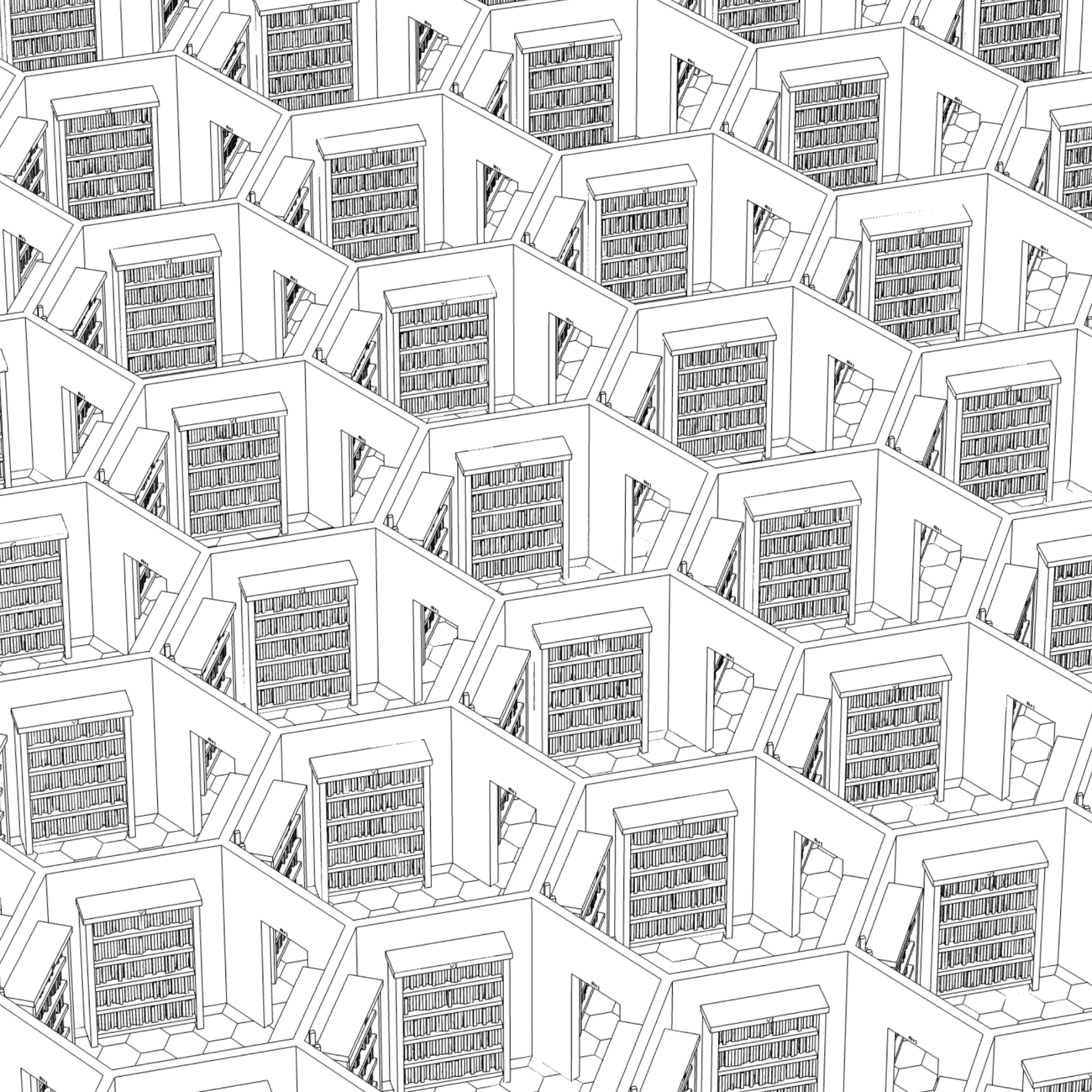
Isometric view of countless book-filled hexagonal galleries connected by bridges and spiral stairs, continuing beyond every edge of the image
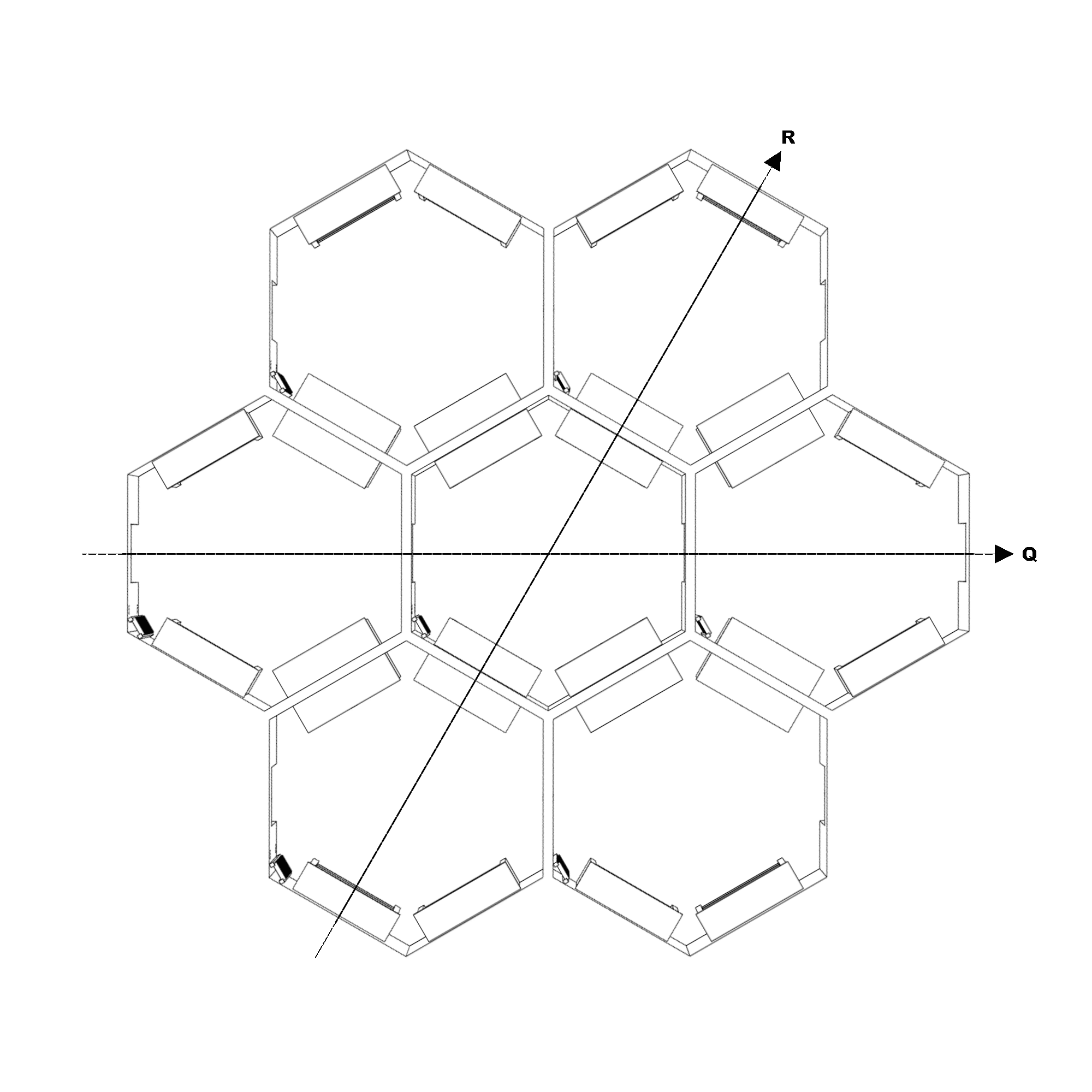
Plan of a hexagonal gallery showing 4 walls of 5 bookcases, 2 opposing doors, a horizontal Q axis and an R axis inclined at 60°

Why hexagons?

Borges distributes 20 bookcases across 4 sides—5 on each—and opens another side onto a vestibule. For the sequence to continue, the 6th can be read as an opposing passage. The plan then resembles a honeycomb without centre or queen: a perfect collective order in which meaning itself is never guaranteed.

2 levels for 2 directions

Q and R are not Borges’s names: they are the 2 axes of our hexagonal map.

At each coordinate (Q, R), imagine 2 superimposed galleries connected by ladders. On the lower level, 2 opposing doors allow travel only along Q; on the upper level, 2 others follow R. Going up or down keeps the same position on the plan: only the available direction changes.

By alternating a move, a ladder and another move, every gallery in the tiling can be reached, including a neighbour along the 3rd axis.

The vertical link is added to the 2 side doors; if it counted among only 2 connections in total, the network would remain a simple line. In the explorer, Q, R and LEVEL remain 3 direct coordinates: this model explains the architecture without adding another coordinate to the address.

Every book has its address

The address matters as much as the text. To make that immensity readable, we locate each room by its level and its Q and R coordinates; add the wall, shelf, book number and page number: its text, already written, has always been waiting for you at that address.

LEVEL / Q / R / WALL / SHELF / BOOK / PAGE

An architecture repeated

Each ordinary room opens onto the next and repeats the same order. Its dimensions are fixed; only the address changes.

4
bookcases per room
5
shelves per bookcase
32
books per shelf
410
pages per book
40
lines per page
80
characters per line

Learn more

This page also acknowledges the inspiration of Jonathan Basile’s Library of Babel Opens in a new tab., while retaining its own writing, interpretation, and experience.

Enter without a map.

Chance or a sentence you search for are 2 equally valid ways to begin exploring.

Search